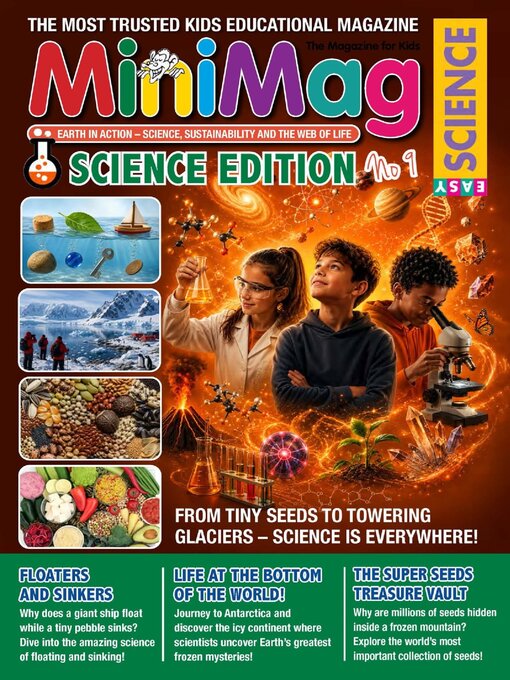
 Special Edition 9
 Special Edition 8
 Special Edition 7
 Special Edition 6
 Special Edition 5
 Special Edition 4
 Special Edition 3
 Special Edition 2
In this special edition of MiniMag, we take a closer look at the latest advancements in bio-innovation, nano technology, and hydrogen fuel. From understanding the building blocks of life, to harnessing the power of tiny particles, we explore the ways in which science is shaping our future. Discover the latest research in bio-innovation, including new ways to fight diseases and create sustainable food sources. Learn about the potential of nano technology in fields like electronics and medicine. And discover how hydrogen fuel is emerging as a clean and renewable energy source. As a children's education magazine, MiniMag, one of the longest running childrens education magazines, provides age-appropriate and engaging content that makes learning about science fun and easy.
MiniMag - Easy Science Special Edition
Dive into Discovery!
Floaters and Sinkers • A fascinating fact about liquids like water is that some things sink into it, while others float on it. What makes things float or sink? Will something that floats always float and a sinker always sink? These are some of the questions we are going to find answers for in this article.
How things float • BUOYANCY is the force that allows objects to float. It happens because of the pressure exerted by the fluid (like water) on an object. When an object is placed in water, it experiences an upward force from the water. If this upward force, called the buoyant force, is greater than or equal to the weight of the object, the object floats. If the buoyant force is less than the object’s weight, it sinks.
The Wonders of Water • Here are some more activities around sinkers and floaters. Let’s start with a puzzle. The theory of Archimedes (page 5) may help you solve this puzzle, or you can try the test below.
Water’s secret skin
How Buoyancy shapes our world • Buoyancy is a fascinating force that influences many aspects of our daily lives and the natural world. From the engineering marvels of submarines to the natural buoyancy of marine animals, understanding this principle helps us appreciate the balance and design in both nature and human inventions.
Ahoy to adventure and sea science • Earth’s Southern Ocean, which surrounds Antarctica, doesn’t usually receive much attention when you look at a map of the world! Yet, it holds important secrets that can help scientists understand things about our planet better, like its changing climate. Scientists enjoy the adventure of discovering these secrets as research ships go on regular trips to explore these icy waters. One of these ships is the SA Agulhas II from South Africa.
Life as a scientist in Antarctica • A journey to the bottom of the world
Glaciers, a frozen wonderland • NATURE’S ICY SCULPTORS
A journey into the heart of ice • Imagine a river made of ice, so powerful it can carve valleys and shape mountains. These are glaciers, nature’s slow-moving giants, carrying the past and the future in their frozen flow. They might seem like they’re standing still, but glaciers are always on the move, and their journey across the land is one of the most fascinating occurrences in nature.
Super Seeds • Imagine a huge safe, deep inside a frozen mountain near the North Pole. What could possibly be so precious that people want to keep it there? Gold, jewels or money? Nope … the answer? Seeds! Svalbard, the Global Seed Vault, was built 120 m inside a mountain on the Norwegian Island of Spitsbergen to store and protect seeds of as many plants as possible in case a huge disaster hits earth.
Become a horticulturist! • YOU HAVE WHAT IT TAKES
How pulses can save the Earth • Oxygen is pretty easy to get, right? You just breathe. But how do you get the nitrogen that your body needs? You can’t absorb it from the air, because it isn’t in the right...